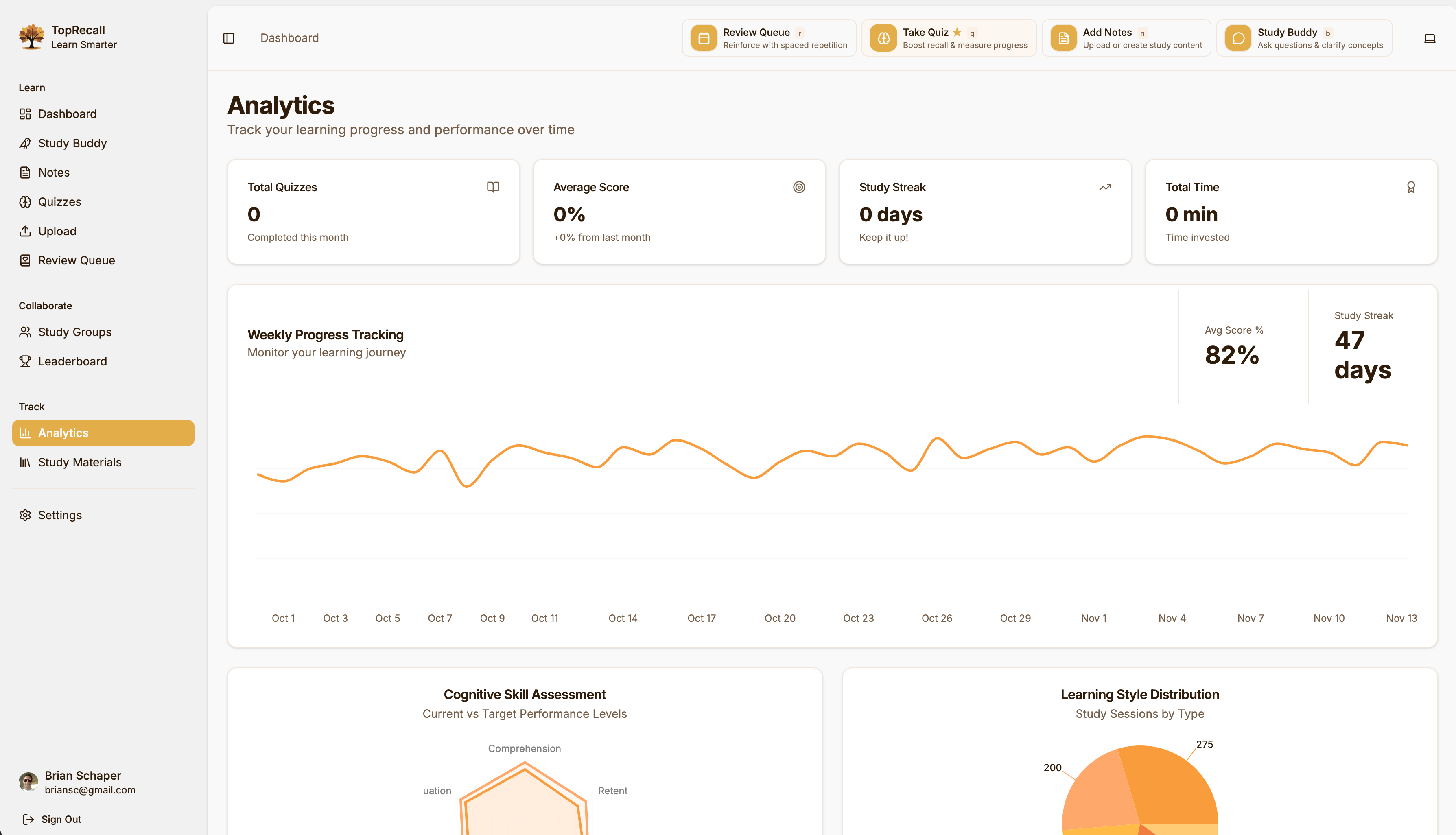
TopRecall started from a simple personal observation: saving notes is easy, remembering them later is hard.
Most study tools help you store material. Fewer tools help you convert that material into active recall, spaced review, targeted feedback, and durable knowledge. That is the gap I wanted TopRecall to work on.
The core product challenge is not “call an AI model and generate questions.” The challenge is building a pipeline that can take messy user inputs, preserve context, generate useful practice, and adapt over time as the user learns.
The product loop
The study loop I care about looks like this:
- A user captures material.
- The system extracts and structures the content.
- The system generates practice questions.
- The user answers.
- The system gives feedback.
- Future review adapts based on performance.
That loop matters because memory is not built by passively rereading notes. It is built by retrieval practice, feedback, and repeated exposure at the right time.
AI is useful in this system because it can lower the friction between raw material and practice. It can turn a page of notes into quiz questions, identify weak areas, and explain why an answer was incomplete.
But the AI layer has to sit inside a disciplined product architecture.
Input: accept the way people actually study
Students do not all study the same way. Some type notes. Some write by hand. Some record lectures. Some collect PDFs, slides, screenshots, and textbook excerpts.
TopRecall’s pipeline is designed around multiple input types:
- Typed notes
- Uploaded files
- Images of handwritten notes
- Audio recordings
- Existing study material
Each input type has different failure modes. Audio needs transcription quality checks. Handwriting needs OCR confidence. PDFs need layout-aware parsing. Uploaded notes need topic segmentation. The system cannot treat every source as clean text.
The ingestion layer should capture where the material came from, how it was processed, and what confidence the system has in the extracted content.
Extraction: turn content into study units
Raw text is not enough. A useful study system needs structure.
For TopRecall, I think in terms of study units:
- Concepts
- Definitions
- Examples
- Procedures
- Facts
- Relationships
- Common mistakes
- Open questions
The extraction step turns source material into these units. A paragraph about cellular respiration, for example, might produce concepts, vocabulary, process steps, and cause-effect relationships. A lecture transcript might need summarization, deduplication, and topic boundaries before it is useful.
This is where MongoDB is a natural fit. Study material is semi-structured and evolves over time. A note, quiz, transcript, image extraction, and performance history do not all have the same shape. MongoDB gives the product room to represent that complexity while still indexing the fields that matter for retrieval and review.
The tradeoff is discipline. Flexible documents still need versioning, validation, and migration patterns. Schema-less should not mean structure-less.
Generation: quizzes should be grounded
AI-generated quizzes are only useful if they stay close to the user’s material.
I do not want a generic quiz about a topic. I want a quiz that reflects what the user actually uploaded, at the right level of difficulty, with answer feedback that can point back to the source.
That means quiz generation should use:
- Source-grounded context
- Question type constraints
- Difficulty targets
- Expected answer criteria
- Citation or source references
- Validation before saving
Different question types serve different learning goals. Multiple choice can help with recognition, but short-answer and explanation questions are better for active recall. A good study pipeline should support more than one mode.
The system should also avoid over-generating. Ten useful questions are better than fifty shallow ones.
Feedback: the answer matters more than the score
The most valuable moment in a study product is after the user answers.
A score alone is not enough. The user needs to know what they understood, what they missed, and what to review next. AI can help here by comparing the user’s answer against the expected criteria and generating targeted feedback.
The feedback loop should capture:
- Whether the answer was correct
- Which concepts were missing
- Whether the user used the right terminology
- Confidence level
- Suggested review material
- When the concept should come back
This turns quizzes into a memory system instead of a one-off content generator.
Adaptation: memory needs history
A study app gets more useful when it remembers what the user struggles with.
TopRecall’s data model needs to track performance over time, not just individual quiz attempts. The system should know which concepts are stable, which are fading, and which need a different explanation.
That history can drive:
- Spaced repetition schedules
- Difficulty adjustment
- Personalized quiz generation
- Topic-level progress
- Remediation suggestions
- Study group insights
The key is to separate content mastery from activity volume. A user answering many easy questions is not the same as a user mastering difficult material.
Trust: make the AI inspectable
For an AI study product, trust is practical. Users need to know where a question came from and why feedback was given.
That means the product should expose source links, quoted snippets, or references back to the original material where possible. If the AI creates a question from a handwritten note, the user should be able to trace it back to the note. If feedback says an answer is incomplete, it should be clear what concept was missing.
This also helps the product improve. When users correct the AI, that correction should become a signal for future generation and evaluation.
The architecture in one path
The pipeline looks roughly like this:
- User uploads notes, audio, images, or files.
- The ingestion service stores the original artifact and metadata.
- Extraction services produce text, structure, and confidence signals.
- Study units are saved with source references and schema versions.
- Retrieval selects relevant units for quiz generation.
- OpenAI generates grounded questions and answer criteria.
- Validation checks structure, source alignment, and policy rules.
- The user answers and receives targeted feedback.
- Performance history updates future review scheduling.
The important part is that every stage leaves behind useful state. If generation is poor, I can inspect the extraction. If feedback is off, I can inspect the expected criteria. If a topic is over-tested, I can inspect scheduling logic.
What I would keep refining
The biggest improvements in a product like this usually come from the boring parts:
- Better source parsing
- Better duplicate detection
- Better evaluation sets
- Better quiz validation
- Better review scheduling
- Better user correction flows
AI makes the experience possible, but learning outcomes come from the full loop. TopRecall is interesting to me because it is not just an AI wrapper. It is a data product, an education product, and a memory system wrapped into one user experience.
The goal is simple: help people turn the material they already collect into knowledge they can actually retrieve when it matters.